






Footwear of the Future: Sneakers Will Soon Be 3D-Printed
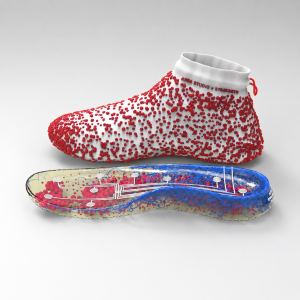
Not so long ago, 3D printing seemed like a technology from the world of architectural models, medicine and design experiments. Today, it is moving closer and closer to fashion, especially footwear. And while in the past sneakers were chosen according to a standard size chart, in the future a pair may be created almost like an individual project: based on the shape of the foot, walking style, level of activity and even lifestyle.
The idea sounds futuristic, but it no longer feels like science fiction. Designers and technology companies are working on footwear that is not only printed on a 3D printer, but also collects data about the wearer and helps create the next, more accurate version of the pair. In this way, sneakers are gradually turning from an ordinary item into a personal comfort tool.
Why 3D printing can change the footwear industry
The main problem with mass-produced footwear is that it is created for an average foot. The size may be right, but the last may feel tight, the heel may rub, and the sole may not take into account the way a person walks. That is why even fashionable sneakers can sometimes be comfortable only at first glance.
3D printing offers a different approach: instead of forcing the foot to adapt to the shoe, it allows footwear to be created around the foot. In theory, this technology could take into account instep height, forefoot width, pressure distribution, movement patterns and the areas where a person needs extra support.
How sneakers of the future may work
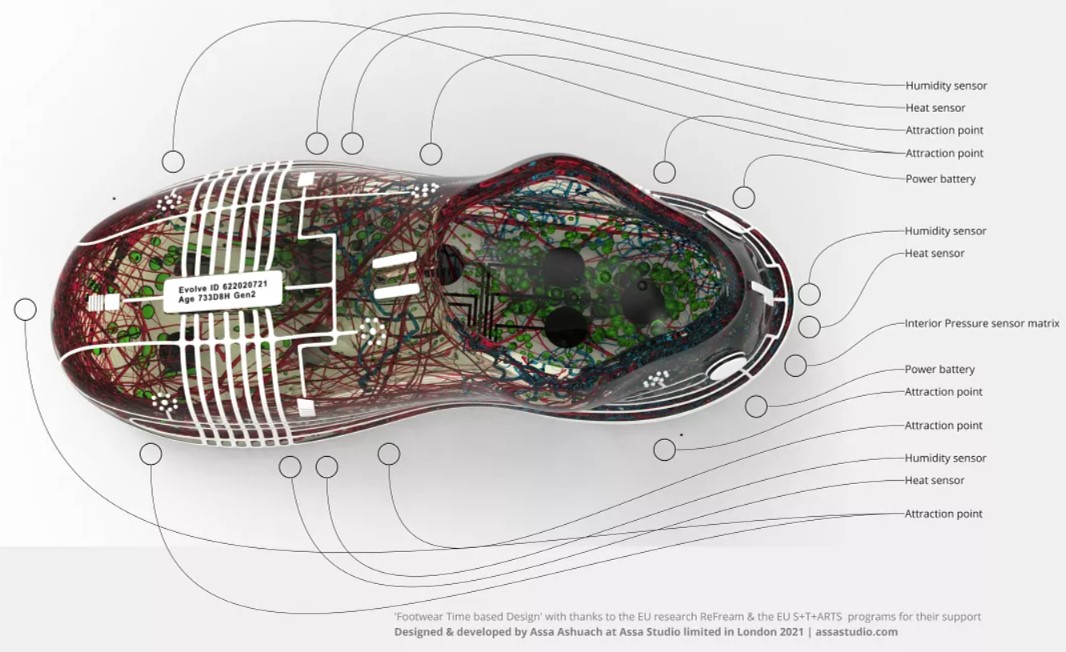
One of the most interesting examples is the Evolve smart footwear concept, created with the participation of designer Assa Ashuach. Such a pair uses 3D-printed elements and sensors that can collect data about movement, pressure, temperature and other parameters. The idea is for the footwear to gradually “learn” the wearer and help create a more personalized next version.
In simple terms, the first pair may not be the final product, but the beginning of the process. A person wears the shoes, the system analyzes how they move, where the foot receives more pressure and how wearing conditions change. Then, based on this data, a new pair can be 3D printed with a more accurate fit.
Why this matters for comfort
Footwear comfort does not depend only on size. Two women with the same size 38 can have completely different foot widths, instep heights, toe shapes and walking styles. That is why one standard pair may feel ideal for one person, while for another it may feel tight or unstable.
3D printing can solve part of this problem. For example, the sole could be softer in one zone and firmer in another, while the upper could adapt better to the individual shape of the foot. This is especially interesting for everyday footwear and sports shoes, where support, cushioning and ventilation play an important role.
What advantages 3D-printed footwear has
The first advantage is personalization. Instead of a standard pair, you can get footwear that better takes into account the specific features of your foot. The second advantage is the possibility of tuning the sole more precisely: adding support in one area, making the construction lighter in another, or increasing cushioning where needed.
The third advantage is potentially more rational production. If footwear is printed for a specific person, brands do not need to produce huge batches that may later remain in warehouses. In the future, this could also influence the sustainability of the fashion industry, although for now the technology remains expensive and complex for the mass market.
What about the design?
3D printing gives designers a freedom that is difficult to achieve through traditional production. The sole can look like a complex network, the upper like a flexible structure, and the entire pair like an object from the future. Such models do not always resemble the canvas shoes or basic sneakers we are used to, but this is exactly where a new aesthetic appears.
Most likely, the first 3D-printed models for a wider audience will look unusual. But over time, the technology may become less visible from the outside. This means that a person will be able to choose both a futuristic pair and a calmer design that fits easily into an everyday wardrobe with jeans, a coat or women’s accessories.
What questions still remain
This type of footwear has not only advantages, but also important questions. The first is the price. Individual development, sensors, a digital model and printing currently make such pairs more expensive than ordinary shoes. The second is speed: personalized footwear may require time for data collection, processing and production.
The third question is privacy. If footwear collects information about movement, pressure, temperature and the wearer’s habits, it is important to understand where this data is stored and who has access to it. For the fashion of the future, this will be just as important as comfort and appearance.
Will such sneakers replace ordinary footwear?
Completely — probably not, at least not in the next few years. Classic footwear, canvas shoes, boots, sandals and ordinary sneakers will remain part of the wardrobe. But 3D printing may occupy a separate niche: personalized pairs for sports, long walks, special foot needs and people who find it difficult to choose standard footwear.
Most likely, the technology will first appear in the premium and sports segments, and only later become more accessible. This often happens with innovations: first they look like an experiment, then like an expensive trend, and only after that do they gradually move into everyday fashion.
How this may influence the way we choose shoes
If 3D-printed sneakers become widespread, the process of buying footwear may change. Instead of simply choosing a size, a person may scan the foot, indicate wearing habits, choose the level of cushioning, sole type, materials and even the degree of ventilation. Footwear will become not just a product, but a personal setting.
This is especially relevant for those who walk a lot, do sports or feel discomfort in standard models. But even without 3D printing, it is already worth choosing footwear more carefully: taking into account not only the trend, but also the fit, support, material and wearing scenario.
What we can do already
While the sneakers of the future are still approaching the mass market, the basis of comfort remains the right choice of footwear. Shoes should not squeeze, rub, overheat the foot or force the toes to compress. If you need a pair for every day, it is better to choose models with a good fit, stable sole and quality materials.
For the cooler season, you can pay attention to practical transitional boots; for an active rhythm, comfortable sneakers; and for everyday outfits, versatile models from the footwear catalog that match your style and lifestyle.
Advice from Happy Heels
Technologies change, but the main rule remains the same: footwear should be comfortable specifically for you. Even the most fashionable or innovative pair will not be a good choice if it squeezes, does not support the foot well or does not match your daily rhythm.
That is why it is worth seeing footwear as an important part of self-care. Look not only at the design, but also at the fit, material, stability, weight and how the pair feels after several hours of wear. Perhaps in the future artificial intelligence will do this for us, but for now the best guide is your own comfort.
Quick summary
- 3D printing can make footwear more personalized.
- Sneakers of the future may take into account foot shape, walking style and pressure distribution.
- Sensors can help collect data for the next, more accurate pair.
- The main advantages of the technology are individual fit, sole tuning and new design.
- The main questions are price, production speed and data privacy.
- Ordinary footwear will not disappear, but smarter and more personal models will appear alongside it.
Conclusion
Footwear of the future is already ceasing to be a fantasy. 3D printing, sensors and artificial intelligence are gradually changing our idea of what sneakers can be. Perhaps very soon footwear will no longer be sold only by size, but created individually — according to the foot, movement and habits of a specific person.
But even the most advanced technologies do not cancel the main thing: footwear should be comfortable, high-quality and suitable for your lifestyle. This is exactly where the future is heading — from one mass-produced pair for everyone to a personal pair for each person.
Photo: Assa Ashuach