






How Global Footwear Consumption Is Distributed
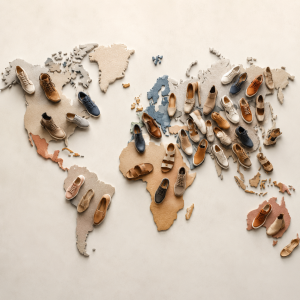
The global footwear market no longer has the same structure everywhere: in some regions, people buy more pairs per person, while in others, demand grows because of population size, urbanization and the expansion of the middle class. That is why today it is important to look not only at total volumes, but also at the geography of consumption. According to the latest industry data, the center of global demand is moving more clearly toward Asia, even though the leaders in consumption per person are other regions.
Simply put, global footwear consumption is distributed unevenly. The largest volume belongs to Asia, which already forms more than half of global demand. Europe and North America consume fewer pairs in total, but remain markets with a high level of purchases per person. At the same time, Africa is gradually increasing its share, while smaller markets such as Moldova reflect several global trends at once: price sensitivity, dependence on imports and interest in universal everyday footwear.
Why Asia became the main center of global demand
Today, Asia is the largest consumer region in the global footwear market. About 56% of global footwear consumption belongs to this region. This result is explained primarily by the demographic factor: a very large part of the world’s population lives here, and even moderate consumption per person creates enormous total demand.
However, Asia does not lead because each resident buys the most pairs. Average consumption here is about 2.6 pairs per person, which is lower than in North America and Europe. Still, the scale of the markets in China, India, Indonesia, Vietnam and other countries makes the region the clear leader by total volume.
Which regions shape the global footwear market
If we look at the global map of demand more broadly, the picture is clear: Asia holds first place with a huge lead, Europe and North America maintain strong positions thanks to purchasing activity and interest in fashion and comfort, while Africa is gradually increasing its presence in global footwear consumption. The African continent already accounts for about 10.7% of global demand.
This shows that the market is becoming more multipolar. If in the past the main reference points were mostly Europe and the United States, today the dynamics are increasingly influenced by Asian and developing markets. For manufacturers, retailers and online stores, this means the need to consider different demand scenarios: from the mass basic segment to fashionable and technological footwear.
Where people buy more shoes per person
Interestingly, the leader in footwear consumption per capita is not Asia, but North America. Here, the average reaches about 4.6 pairs per person per year. Europe also remains a very active consumer market, with about 4.1 pairs per person. For comparison, in Asia this figure is 2.6 pairs, while in Africa it is about 1.6 pairs.
This difference is explained by income levels, the frequency of wardrobe renewal, climate, consumption culture and lifestyle. In developed markets, footwear is bought more often not only out of necessity, but also as part of seasonal outfit updates. Demand is growing for separate pairs for different situations: everyday wear, office, travel, sport, vacation and special occasions.
The largest footwear-consuming countries
If we move from regions to countries, China remains the largest market, with around 4.8 billion pairs per year. India follows with about 2.8 billion pairs, while the United States ranks third with around 1.95 billion pairs. These three countries set the scale for the entire global market and strongly influence assortment, production and logistics in the footwear industry.
However, large consumption volumes are not always only about fashion. Very often they are also about basic needs, school shoes, work models, sport pairs, seasonal footwear replacement and the growth of urban populations. That is why the structure of demand can differ greatly from one country to another.
What influences global footwear consumption
The distribution of demand is influenced by several factors. The first is demographics. The larger the population, the higher the total consumption volume. The second is income level: in more developed countries, people buy new pairs more often and respond more easily to trends. The third factor is climate. In countries with clear seasonality, the footwear wardrobe is usually broader: summer, transitional and winter models are needed.
Urbanization and lifestyle are also important. Residents of large cities more often choose universal sneakers, practical everyday models and comfortable footwear for the office and walks. In addition, e-commerce increasingly influences the market: online stores make it easier to compare prices, brands and styles, stimulating consumption in different countries.
What these trends show in the case of Moldova
Moldova is not one of the largest footwear markets in the world, but it reflects well the consumer habits of small European countries. Here, the market noticeably depends on imports, seasonal demand and buyers’ sensitivity to the balance between price and quality. For Moldovan consumers, the most important qualities are versatility, practicality and comfort in everyday wear.
According to Moldova’s official statistics, household spending on clothing and footwear accounts for about 7–8% of consumer expenditures. This means that footwear remains an important, but rational, budget category. Buyers in Moldova often choose models that can be worn for a long time and combined with different clothes: comfortable loafers and moccasins, practical boots, basic canvas shoes, and in the warm season — sandals and light open footwear.
It is also interesting that Moldova’s footwear market feels the impact of inflation and price fluctuations. According to official data, footwear prices in the country continued to rise in 2026, which makes choosing a quality pair even more important. In such conditions, buyers more often focus on durability, comfort and a fair price, while stores focus on a balanced assortment.
How the structure of demand is changing
The modern consumer is less and less likely to buy footwear based on only one criterion. If earlier the choice was built mainly around season and price, today design, comfort, cushioning, material durability and versatility matter much more. In developed markets, interest in functional models is growing, while in developing markets demand remains strong for affordable footwear that withstands daily wear well.
That is why the global market is moving in two directions at the same time: on one hand, mass demand is growing in Asia and Africa; on the other, high purchase intensity remains in Europe and North America. For retail, the conclusion is simple: the brands and stores that win are those that can offer a clear assortment adapted to the real habits and needs of buyers. More ideas and current models can be found in the footwear catalog.
Quick summary
- Asia has the largest share of global footwear consumption — about 56%.
- Asia’s dominance is mainly linked to its large population, not to the highest consumption per person.
- North America leads in pairs per capita — about 4.6 pairs per year.
- Europe also remains an active market, with about 4.1 pairs per person.
- Africa is gradually increasing its share of global demand, but consumption per person remains lower.
- In Moldova, footwear remains an important but rational spending category, where comfort, price and versatility matter most.
Conclusion
Global footwear consumption is distributed unevenly, and this difference is becoming more visible. Asia already forms the largest part of global demand thanks to its large population, North America and Europe lead by the number of pairs per person, while Africa is gradually strengthening its position. At the same time, small markets such as Moldova show how important practicality, price and versatility remain.
That is why, when analyzing the footwear market, it is important to look not only at the numbers, but also at buyer behavior. Behind each region are different habits, climates, income levels and lifestyles. The future of global footwear consumption will therefore be shaped not by one single center of power, but by a combination of demographics, economics and changing fashion preferences.